Adder Simulation
Full adder and ripple carry adder
A full adder has three input bits: $a$, $b$, and $i$ (carry-in) and $o$ (carry-out) and $s$ (sum). The sum of the three input bits is represented using these two output bits.
A ripple-carry adder computes the sum of two multi-bit integers by cascading multiple full adders, as illustrated below:
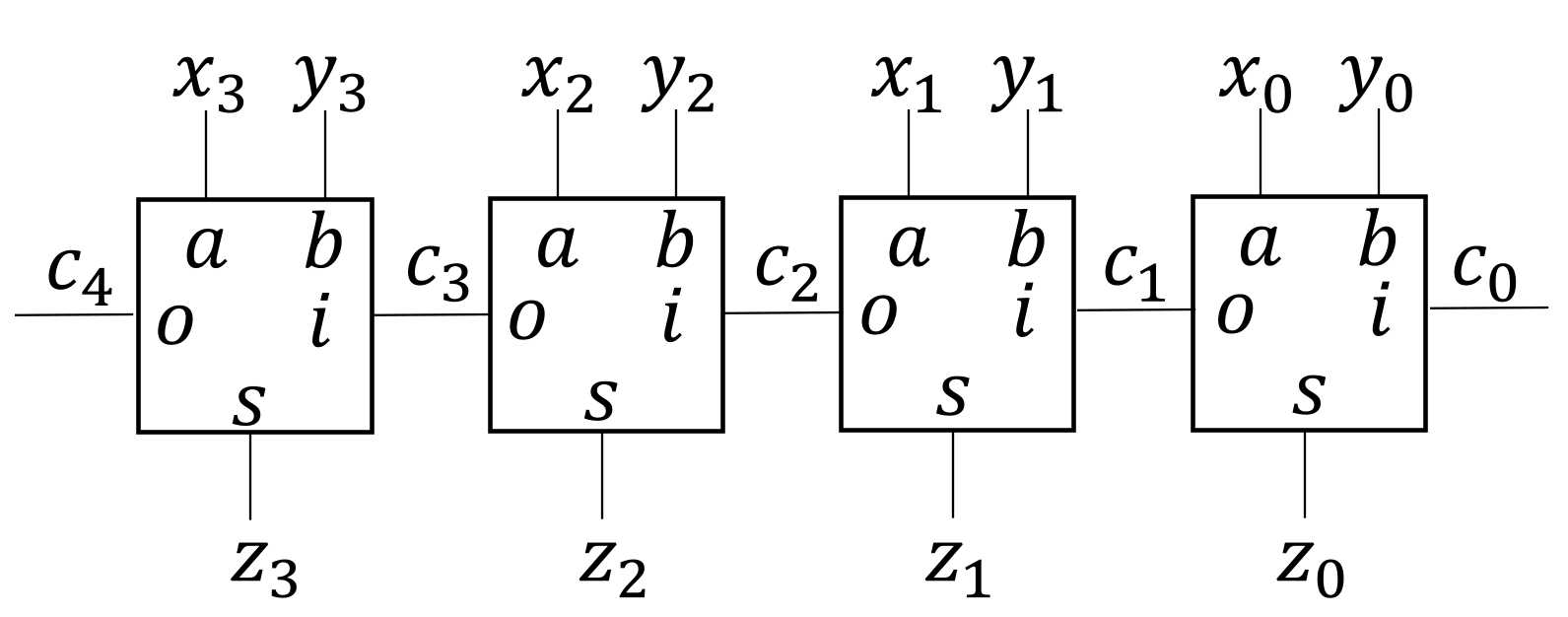
This ripple-carry adder computes the sum of two 4-bit integers $x_3x_2x_1x_0$ and $y_3y_2y_1y_0$ and outputs the 4-bit sum$z_3z_2z_1z_0$ using four full adders. The corresponding 5-bit carry signals $c_4c_3c_2c_1c_0$ are also shown.
QUBO formulation for full adder
A full adder can be formulated using the following expression:
\[\begin{aligned} fa(a,b,i,c,s) &=((a+b+i)-(2o+s))^2 \end{aligned}\]This expression attains its minimum value of 0 if and only if the five variables take values consistent with a valid full-adder operation. The following QUBO++ program verifies this formulation using the exhaustive solver:
#define MAXDEG 2
#include <qbpp/qbpp.hpp>
#include <qbpp/exhaustive_solver.hpp>

int main() {
  auto a = qbpp::var("a");
  auto b = qbpp::var("b");
  auto i = qbpp::var("i");
  auto o = qbpp::var("o");
  auto s = qbpp::var("s");
  auto fa = (a + b + i) - (2 * o + s) == 0;
  fa.simplify_as_binary();
  auto solver = qbpp::exhaustive_solver::ExhaustiveSolver(fa);
  auto sol = solver.search_optimal_solutions();
  std::cout << sol << std::endl;
}
In this QUBO program, the constraint $fa(a,b,i,c,s)$ is implemented using the equality operator ==, which intuitively represents the constraint $a+b+i=2o+s$. The program produces the following output, confirming that the expression correctly models a full adder:
(0) 0:{{a,0},{b,0},{i,0},{o,0},{s,0}}
(1) 0:{{a,0},{b,0},{i,1},{o,0},{s,1}}
(2) 0:{{a,0},{b,1},{i,0},{o,0},{s,1}}
(3) 0:{{a,0},{b,1},{i,1},{o,1},{s,0}}
(4) 0:{{a,1},{b,0},{i,0},{o,0},{s,1}}
(5) 0:{{a,1},{b,0},{i,1},{o,1},{s,0}}
(6) 0:{{a,1},{b,1},{i,0},{o,1},{s,0}}
(7) 0:{{a,1},{b,1},{i,1},{o,1},{s,1}}
If some bits are fixed, the valid values of the remaining bits can be derived. For example, the three input bits can be fixed using the replace() function:
fa.replace({{a, 1}, {b, 1}, {i, 0}});
The program then produces the following output:
(0) 0:{{o,1},{s,0}}
Conversely, if the two output bits are fixed:
fa.replace({{o, 1}, {s, 0}});
the program produces all valid combinations of the input bits:
(0) 0:{{a,0},{b,1},{i,1}}
(1) 0:{{a,1},{b,0},{i,1}}
(2) 0:{{a,1},{b,1},{i,0}}
Simulating a ripple carry adder using multiple full adders
Using the QUBO expression for a full adder, we can construct a QUBO expression that simulates a ripple-carry adder. The following QUBO++ program creates a QUBO expression for simulating a 4-bit adder by combining four full adders:
#define MAXDEG 2
#include <qbpp/qbpp.hpp>
#include <qbpp/exhaustive_solver.hpp>

int main() {
  auto a = qbpp::var("a");
  auto b = qbpp::var("b");
  auto i = qbpp::var("i");
  auto o = qbpp::var("o");
  auto s = qbpp::var("s");
  auto fa = (a + b + i) - (2 * o + s) == 0;

  auto x = qbpp::var("x", 4);
  auto y = qbpp::var("y", 4);
  auto c = qbpp::var("c", 5);
  auto z = qbpp::var("s", 4);

  auto fa0 = qbpp::replace(fa, {{a, x[0]}, {b, y[0]}, {i, c[0]}, {o, c[1]}, {s, z[0]}});
  auto fa1 = qbpp::replace(fa, {{a, x[1]}, {b, y[1]}, {i, c[1]}, {o, c[2]}, {s, z[1]}});
  auto fa2 = qbpp::replace(fa, {{a, x[2]}, {b, y[2]}, {i, c[2]}, {o, c[3]}, {s, z[2]}});
  auto fa3 = qbpp::replace(fa, {{a, x[3]}, {b, y[3]}, {i, c[3]}, {o, c[4]}, {s, z[3]}});
  auto adder = fa0 + fa1 + fa2 + fa3;
  adder.simplify_as_binary();

  auto solver = qbpp::exhaustive_solver::ExhaustiveSolver(adder);
  auto sol = solver.search_optimal_solutions();
  std::cout << sol << std::endl;
}
In this QUBO++ program, four qbpp::Expr objects representing full adders are created using the replace() function and combined into a single expression, adder. The Exhaustive Solver is then used to enumerate all optimal solutions.
This program produces 512 valid solutions, corresponding to all possible input combinations of a 4-bit adder:
(0) 0:{{x[0],0},{x[1],0},{x[2],0},{x[3],0},{y[0],0},{y[1],0},{y[2],0},{y[3],0},{c[0],0},{c[1],0},{c[2],0},{c[3],0},{c[4],0},{s[0],0},{s[1],0},{s[2],0},{s[3],0}}
(1) 0:{{x[0],0},{x[1],0},{x[2],0},{x[3],0},{y[0],0},{y[1],0},{y[2],0},{y[3],0},{c[0],1},{c[1],0},{c[2],0},{c[3],0},{c[4],0},{s[0],1},{s[1],0},{s[2],0},{s[3],0}}
(2) 0:{{x[0],0},{x[1],0},{x[2],0},{x[3],0},{y[0],0},{y[1],0},{y[2],0},{y[3],1},{c[0],0},{c[1],0},{c[2],0},{c[3],0},{c[4],0},{s[0],0},{s[1],0},{s[2],0},{s[3],1}}
(3) 0:{{x[0],0},{x[1],0},{x[2],0},{x[3],0},{y[0],0},{y[1],0},{y[2],0},{y[3],1},{c[0],1},{c[1],0},{c[2],0},{c[3],0},{c[4],0},{s[0],1},{s[1],0},{s[2],0},{s[3],1}}

... omitted ...

(510) 0:{{x[0],1},{x[1],1},{x[2],1},{x[3],1},{y[0],1},{y[1],1},{y[2],1},{y[3],1},{c[0],0},{c[1],1},{c[2],1},{c[3],1},{c[4],1},{s[0],0},{s[1],1},{s[2],1},{s[3],1}}
(511) 0:{{x[0],1},{x[1],1},{x[2],1},{x[3],1},{y[0],1},{y[1],1},{y[2],1},{y[3],1},{c[0],1},{c[1],1},{c[2],1},{c[3],1},{c[4],1},{s[0],1},{s[1],1},{s[2],1},{s[3],1}}
Alternatively, we can define a C++ function fa to construct full-adder constraints in a more concise and readable manner:
#define MAXDEG 2
#include <qbpp/qbpp.hpp>
#include <qbpp/exhaustive_solver.hpp>

qbpp::Expr fa(qbpp::Var a, qbpp::Var b, qbpp::Var i, qbpp::Var o, qbpp::Var s) {
  return (a + b + i) - (2 * o + s) == 0;
}

int main() {
  auto x = qbpp::var("x", 4);
  auto y = qbpp::var("y", 4);
  auto c = qbpp::var("c", 5);
  auto z = qbpp::var("s", 4);
  auto fa0 = fa(x[0], y[0], c[0], c[1], z[0]);
  auto fa1 = fa(x[1], y[1], c[1], c[2], z[1]);
  auto fa2 = fa(x[2], y[2], c[2], c[3], z[2]);
  auto fa3 = fa(x[3], y[3], c[3], c[4], z[3]);
  auto adder = fa0 + fa1 + fa2 + fa3;
  adder.simplify_as_binary();
  auto solver = qbpp::exhaustive_solver::ExhaustiveSolver(adder);
  auto sol = solver.search_optimal_solutions();
  std::cout << sol << std::endl;
}
This program produces the same 512 optimal solutions as the previous implementation.
If some of the binary variables are fixed, the valid values of the remaining variables can be derived using the Exhaustive Solver. For example, the following qbpp::MapList object ml fixes the carry-in, carry-out, and sum bits:
  qbpp::MapList ml = {{c[4], 1}, {c[0], 0}, {z[3], 1},
                      {z[2], 1}, {z[1], 0}, {z[0], 1}};
  adder.replace(ml);
The resulting program produces the following output:
(0) 0:{{x[0],0},{x[1],1},{x[2],1},{x[3],1},{y[0],1},{y[1],1},{y[2],1},{y[3],1},{c[1],0},{c[2],1},{c[3],1}}
(1) 0:{{x[0],1},{x[1],1},{x[2],1},{x[3],1},{y[0],0},{y[1],1},{y[2],1},{y[3],1},{c[1],0},{c[2],1},{c[3],1}}