Permutation matrix generation
Many combinatorial optimization problems are permutation-based in the sense that the objective is to find an optimal permutation. As a fundamental technique for formulating such optimization problems, a matrix of binary variables is used in their QUBO formulation.
Permutation matrix
Let $X=(x_{i,j})$ ($0\leq i,j\leq n-1$) is a matrix of $n\times n$ binary values. The matrix $X$ is called a permutation matrix if and only if every row and every column has exactly one entry equal to 1, as shown below.
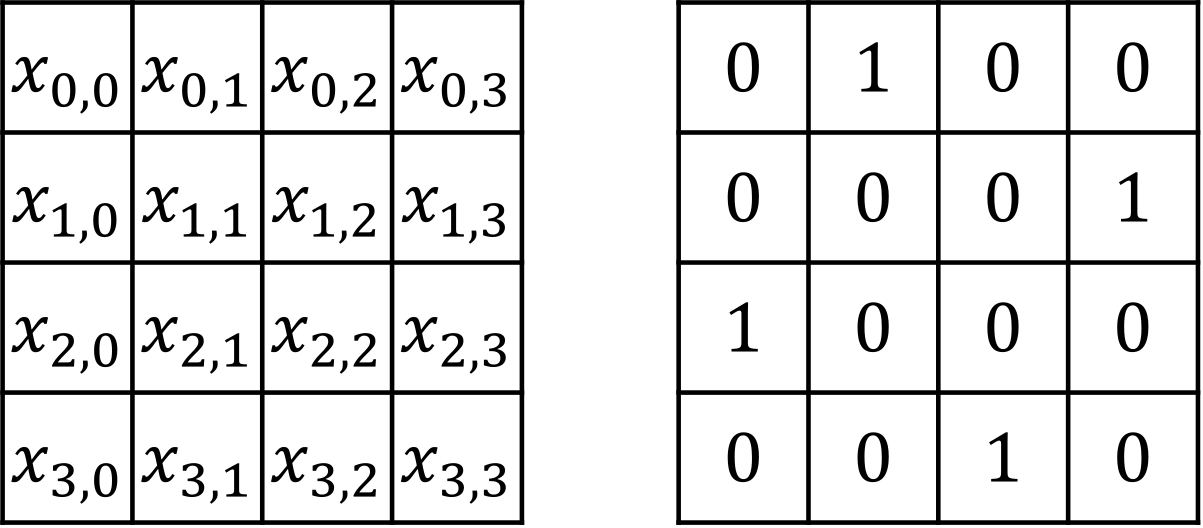
A permutation matrix represents a permutation of $n$ numbers $(0,1,\ldots,n-1)$, where $x_{i,j} = 1$ if and only if the $i$-th element is $j$. For example, the above permutation matrix represents the permutation $(1,2,0,3)$.
QUBO formulation for permutation matrices
A binary variable matrix $X=(x_{i,j})$ ($0\leq i,j\leq n-1$) stores a permutation matrix if and only if the sum of each row and each column is 1. Thus, the following QUBO function takes the minimum value 0 if and only if $X$ stores a permutation matrix:
\[\begin{aligned} f(X) &= \sum_{i=0}^{n-1}\left(1-\sum_{j=0}^{n-1}x_{i,j}\right)^2+\sum_{j=0}^{n-1}\left(1-\sum_{i=0}^{n-1}x_{i,j}\right)^2 \end{aligned}\]QUBO++ program for generating permutation matrices
We can design a QUBO++ program based on the formula $f(X)$ above as follows:
#define MAXDEG 2
#include <qbpp/qbpp.hpp>
#include <qbpp/exhaustive_solver.hpp>

int main() {
  auto x = qbpp::var("x", 4, 4);
  auto f = qbpp::expr();

  for (size_t i = 0; i < 4; i++) {
    auto s = qbpp::expr();
    for (size_t j = 0; j < 4; j++) {
      s += x[i][j];
    }
    f += qbpp::sqr(1 - s);
  }

  for (size_t j = 0; j < 4; j++) {
    auto s = qbpp::expr();
    for (size_t i = 0; i < 4; i++) {
      s += x[i][j];
    }
    f += qbpp::sqr(1 - s);
  }

  f.simplify_as_binary();
  auto solver = qbpp::exhaustive_solver::ExhaustiveSolver(f);
  auto sols = solver.search_optimal_solutions();
  for (size_t k = 0; k < sols.size(); k++) {
    const auto& sol = sols[k];
    std::cout << "Solution " << k << " : " << sol(x) << std::endl;
  }
}
In this program, qbpp::var("x",4,4) returns a qbpp::Vector<qbpp::Vector<qbpp::Var>> object of size $4\times 4$ named x. For a qbpp::Expr object f, two double for-loops adds formulas for $f(X)$. Using the Exhaustive Solver, all optimal solutions are computed and stored in sols. All solutions in sols are displayed one-by-one. Here, sol(x) returns a matrix of values of x in sol. This program outputs all 24 permutations as follows:
Solution 0 : {{0,0,0,1},{0,0,1,0},{0,1,0,0},{1,0,0,0}}
Solution 1 : {{0,0,0,1},{0,0,1,0},{1,0,0,0},{0,1,0,0}}
Solution 2 : {{0,0,0,1},{0,1,0,0},{0,0,1,0},{1,0,0,0}}
Solution 3 : {{0,0,0,1},{0,1,0,0},{1,0,0,0},{0,0,1,0}}
Solution 4 : {{0,0,0,1},{1,0,0,0},{0,0,1,0},{0,1,0,0}}
Solution 5 : {{0,0,0,1},{1,0,0,0},{0,1,0,0},{0,0,1,0}}
Solution 6 : {{0,0,1,0},{0,0,0,1},{0,1,0,0},{1,0,0,0}}
Solution 7 : {{0,0,1,0},{0,0,0,1},{1,0,0,0},{0,1,0,0}}
Solution 8 : {{0,0,1,0},{0,1,0,0},{0,0,0,1},{1,0,0,0}}
Solution 9 : {{0,0,1,0},{0,1,0,0},{1,0,0,0},{0,0,0,1}}
Solution 10 : {{0,0,1,0},{1,0,0,0},{0,0,0,1},{0,1,0,0}}
Solution 11 : {{0,0,1,0},{1,0,0,0},{0,1,0,0},{0,0,0,1}}
Solution 12 : {{0,1,0,0},{0,0,0,1},{0,0,1,0},{1,0,0,0}}
Solution 13 : {{0,1,0,0},{0,0,0,1},{1,0,0,0},{0,0,1,0}}
Solution 14 : {{0,1,0,0},{0,0,1,0},{0,0,0,1},{1,0,0,0}}
Solution 15 : {{0,1,0,0},{0,0,1,0},{1,0,0,0},{0,0,0,1}}
Solution 16 : {{0,1,0,0},{1,0,0,0},{0,0,0,1},{0,0,1,0}}
Solution 17 : {{0,1,0,0},{1,0,0,0},{0,0,1,0},{0,0,0,1}}
Solution 18 : {{1,0,0,0},{0,0,0,1},{0,0,1,0},{0,1,0,0}}
Solution 19 : {{1,0,0,0},{0,0,0,1},{0,1,0,0},{0,0,1,0}}
Solution 20 : {{1,0,0,0},{0,0,1,0},{0,0,0,1},{0,1,0,0}}
Solution 21 : {{1,0,0,0},{0,0,1,0},{0,1,0,0},{0,0,0,1}}
Solution 22 : {{1,0,0,0},{0,1,0,0},{0,0,0,1},{0,0,1,0}}
Solution 23 : {{1,0,0,0},{0,1,0,0},{0,0,1,0},{0,0,0,1}}
NOTE A matrix of binary variables is implemented as a nested vector using
qbpp::Vectorclass. For example,qbpp::var("x",4,4)returns aqbpp::Vector<qbpp::Vector<qbpp::Var>>object. Eachqbpp::Varobject is represented asx[i][j]and the value ofx[i][j]forsolcan be obtained by eithersol(x[i][j])orx[i][j](sol).
QUBO formulation for a permutation matrix using vector functions and operations
Using qbpp::vector_sum(), we can compute the row-wise and column-wise sums of a matrix x of binary variables:
qbpp::vector_sum(x, 1): Computes the sum of each row ofxand returns a vector of sizencontaining these sums.qbpp::vector_sum(x, 0): Computes the sum of each column ofxand returns a vector of sizencontaining these sums.
Note: For a multi-dimensional array
xand an axisk,qbpp::vector_sum(x, k)computes sums along axiskand returns a multi-dimensional array whose dimension is reduced by one. For a 2-dimensional array (matrix)x, axis1corresponds to the row direction, and axis0corresponds to the column direction.
A scalar–vector operation can be used to subtract 1 from each element:
qbpp::vector_sum(x, 1) - 1: subtracts 1 from each row-wise sum.qbpp::vector_sum(x, 0) - 1: subtracts 1 from each column-wise sum.
For these two vectors of size n, qbpp::sqr() squares each element, and qbpp::sum() computes the sum of all elements.
The following QUBO++ program implements a QUBO formulation using these vector functions and operations:
#define MAXDEG 2
#include <qbpp/qbpp.hpp>
#include <qbpp/exhaustive_solver.hpp>

int main() {
  auto x = qbpp::var("x", 4, 4);
  auto f = qbpp::sum(qbpp::sqr(qbpp::vector_sum(x, 1) - 1)) +
           qbpp::sum(qbpp::sqr(qbpp::vector_sum(x, 0) - 1));
  f.simplify_as_binary();
  auto solver = qbpp::exhaustive_solver::ExhaustiveSolver(f);
  auto sols = solver.search_optimal_solutions();
  for (size_t k = 0; k < sols.size(); k++) {
    const auto& sol = sols[k];
    const auto& row = qbpp::onehot_to_int(x(sol), 1);
    const auto& column = qbpp::onehot_to_int(x(sol), 0);
    std::cout << "Solution " << k << ": " << row << ", " << column << std::endl;
  }
}
In this program, x(sol) returns a matrix of assigned values to x in sol, which is a matrix of integers of size . qbpp::onehot_to_int() converts one-hot vectors along the axis to the corresponding integers.
qbpp::onehot_to_int(x(sol), 1): Computes the integer corresponding to each row and returns them as a vector of 4 integers, which represents the permutation.qbpp::onehot_to_int(x(sol), 0): returns the integer corresponding to each column and returns them as a vector of 4 integers, which represents the inverse of the permutation. This program outputs all permutations and their inverse as integer vectors as follows:Solution 0: {3,2,1,0}, {3,2,1,0} Solution 1: {3,2,0,1}, {2,3,1,0} Solution 2: {3,1,2,0}, {3,1,2,0} Solution 3: {3,1,0,2}, {2,1,3,0} Solution 4: {3,0,2,1}, {1,3,2,0} Solution 5: {3,0,1,2}, {1,2,3,0} Solution 6: {2,3,1,0}, {3,2,0,1} Solution 7: {2,3,0,1}, {2,3,0,1} Solution 8: {2,1,3,0}, {3,1,0,2} Solution 9: {2,1,0,3}, {2,1,0,3} Solution 10: {2,0,3,1}, {1,3,0,2} Solution 11: {2,0,1,3}, {1,2,0,3} Solution 12: {1,3,2,0}, {3,0,2,1} Solution 13: {1,3,0,2}, {2,0,3,1} Solution 14: {1,2,3,0}, {3,0,1,2} Solution 15: {1,2,0,3}, {2,0,1,3} Solution 16: {1,0,3,2}, {1,0,3,2} Solution 17: {1,0,2,3}, {1,0,2,3} Solution 18: {0,3,2,1}, {0,3,2,1} Solution 19: {0,3,1,2}, {0,2,3,1} Solution 20: {0,2,3,1}, {0,3,1,2} Solution 21: {0,2,1,3}, {0,2,1,3} Solution 22: {0,1,3,2}, {0,1,3,2} Solution 23: {0,1,2,3}, {0,1,2,3}
Assignment problem and its QUBO formulation
Let $C = (c_{i,j})$ be a cost matrix of size $n \times n$. The assignment problem for $C$ is to find a permutation $p:\lbrace 0,1,\ldots, n-1\rbrace \rightarrow \lbrace 0,1,\ldots, n-1\rbrace$ that minimizes the total cost:
\[\begin{aligned} g(p) &= \sum_{i=0}^{n-1}c_{i,p(i)} \end{aligned}\]We can use a permutation matrix $X = (x_{i,j})$ of size $n \times n$ for a QUBO formulation of this problem by defining:
\[\begin{aligned} g(X) &= \sum_{i=0}^{n-1}\sum_{j=0}^{n-1}c_{i,j}x_{i,j} \end{aligned}\]Clearly, $g(p) = g(X)$ holds if and only if $X$ represents the permutation $p$.
We combine the QUBO formulation for the permutation matrix, $f(X)$, and the total cost, $g(X)$, to obtain a QUBO formulation of the assignment problem:
\[\begin{aligned} h(X) &= P\cdot f(x)+g(x) \\ &=P\left(\sum_{i=0}^{n-1}\left(1-\sum_{j=0}^{n-1}x_{i,j}\right)^2+\sum_{j=0}^{n-1}\left(1-\sum_{i=0}^{n-1}x_{i,j}\right)^2\right)+\sum_{i=0}^{n-1}\sum_{j=0}^{n-1}c_{i,j}x_{i,j} \end{aligned}\]Here, $P$ is a sufficiently large positive constant that prioritizes the permutation constraints encoded in $f(X)$.
QUBO++ program for the assignment problem
We are now ready to design a QUBO++ program for the assignment problem. In this program, a fixed matrix $C$ of size $4\times4$ is given as a nested qbpp::Vector. The formulas for $f(X)$ and $g(X)$ are defined using vector functions and operations. Here, qbpp::vector_sum(x, 1) == 1 returns a QUBO expression that takes the minimum value 0 if the equality is satisfied. In fact, it returns the same QUBO expression as qbpp::sqr(qbpp::vector_sum(x, 1) - 1). Also, c * x returns a matrix obtained by computing the element-wise product of c and x, and therefore qbpp::sum(c * x) returns g(X).
#define MAXDEG 2
#include <qbpp/qbpp.hpp>
#include <qbpp/easy_solver.hpp>

int main() {
  qbpp::Vector<qbpp::Vector<uint32_t>> c = {
      {58, 73, 91, 44}, {62, 15, 87, 39}, {78, 56, 23, 94}, {11, 85, 68, 72}};
  auto x = qbpp::var("x", 4, 4);
  auto f = qbpp::sum(qbpp::vector_sum(x, 1) == 1) +
           qbpp::sum(qbpp::vector_sum(x, 0) == 1);
  auto g = qbpp::sum(c * x);
  auto h = 1000 * f + g;
  h.simplify_as_binary();

  auto solver = qbpp::easy_solver::EasySolver(h);
  solver.time_limit(1.0);

  auto sol = solver.search();
  std::cout << "sol = " << sol << std::endl;
  auto result = qbpp::onehot_to_int(x(sol), 1);
  std::cout << "Result : " << result << std::endl;
  for (size_t i = 0; i < result.size(); ++i) {
    std::cout << "c[" << i << "][" << result[i] << "] = " << c[i][result[i]]
              << std::endl;
  }
}
We use the Easy Solver to find a solution of h. For an Easy Solver object solver for h, the time limit for searching a solution is set to 1.0 seconds by calling the time_limit() member function. The resulting permutation is stored in result, and the selected c[i][j] values are printed in turn. The output of this program is as follows:
sol = 93:{{x[0][0],0},{x[0][1],0},{x[0][2],0},{x[0][3],1},{x[1][0],0},{x[1][1],1},{x[1][2],0},{x[1][3],0},{x[2][0],0},{x[2][1],0},{x[2][2],1},{x[2][3],0},{x[3][0],1},{x[3][1],0},{x[3][2],0},{x[3][3],0}}
Result : {3,1,2,0}
c[0][3] = 44
c[1][1] = 15
c[2][2] = 23
c[3][0] = 11
NOTE For an expression
fand an integerm,f == mreturns an expressionqbpp::sqr(f - m), which takes the minimum value 0 if and only if the equalityf == mis satisfied.