Graph Coloring Problem
Given an undirected graph $G=(V,E)$, the graph coloring problem aims to assign a color to each node so that adjacent nodes receive different colors. More specifically, for a set $C$ of colors, the goal is to find an assignment $\sigma:V\rightarrow C$ such that for every edge $(u,v)\in E$, we have $\sigma(u)\neq \sigma(v)$. The graph coloring problem can be formulated easily as a QUBO expression. Let $V=\lbrace 0,1,\ldots ,n−1\rbrace$ and $C=\lbrace 0,1,\ldots ,m−1\rbrace$. We introduce an $n\times m$ matrix $X=(x_{i,j})$ of binary variables, where $x_{i,j}=1$ if and only if node $i$ is assigned color $j$.
One-hot constraint
Since exactly one color must be assigned to each node, each row of $X$ must be one-hot:
\[\begin{aligned} \text{onehot}&= \sum_{i=0}^{n-1}\Bigl(\sum_{j=0}^{m-1}x_{i,j}==1\Bigr)\\ &=\sum_{i=0}^{n-1}\Bigl(1-\sum_{j=0}^{m-1}x_{i,j}\Bigr)^2 \end{aligned}\]Adjacent nodes must differ
For each edge, its endpoints must not share the same color. This can be penalized as follows:
\[\begin{aligned} \text{different}&= \sum_{(u,v)\in E}x_u\cdot x_v\\ &=\sum_{(u,v)\in E}\sum_{j=0}^{m-1}x_{u,j}x_{v,j} \end{aligned}\]QUBO objective
By combining these expressions, we obtain the QUBO objective function
\[\begin{aligned} f &= \text{onehot}+\text{different} \end{aligned}\]This objective attains the minimum value 0 if and only if a valid $m$-coloring of the graph exists.
QUBO++ formulation
Since any planar graph can be colored with at most four colors, we use a planar graph with 16 nodes and $m=4$ colors as an example. The following QUBO++ program solves this instance:
#define MAXDEG 2
#include <qbpp/qbpp.hpp>
#include <qbpp/easy_solver.hpp>
#include <qbpp/graph.hpp>

int main() {
  const size_t n = 16;
  std::vector<std::pair<size_t, size_t>> edges = {
      {0, 1},   {0, 2},   {0, 4},   {1, 3},   {1, 4},   {1, 7},   {2, 5},
      {2, 6},   {3, 7},   {3, 13},  {3, 15},  {4, 6},   {4, 7},   {4, 14},
      {5, 8},   {6, 8},   {6, 14},  {7, 14},  {7, 15},  {8, 9},   {8, 12},
      {9, 10},  {9, 11},  {9, 12},  {10, 11}, {10, 12}, {10, 13}, {10, 14},
      {10, 15}, {11, 13}, {12, 14}, {13, 15}, {14, 15}};
  const size_t m = 4;

  auto x = qbpp::var("x", n, m);

  auto onehot = qbpp::sum(qbpp::vector_sum(x) == 1);
  auto different = qbpp::Expr(0);
  for (const auto& e : edges) {
    different += qbpp::sum(x[e.first] * x[e.second]);
  }

  auto f = onehot + different;

  f.simplify_as_binary();
  auto solver = qbpp::easy_solver::EasySolver(f);
  solver.target_energy(0);
  auto sol = solver.search();

  std::cout << "onehot = " << sol(onehot) << std::endl;
  std::cout << "different = " << sol(different) << std::endl;

  auto node_color = qbpp::onehot_to_int(sol(x));

  qbpp::graph::GraphDrawer graph;
  for (size_t i = 0; i < n; ++i) {
    graph.add_node(qbpp::graph::Node(i).color(node_color[i] + 1));
  }
  for (const auto& e : edges) {
    graph.add_edge(qbpp::graph::Edge(e.first, e.second));
  }

  graph.write("graph_color.svg");
}
In this program, we first define an $n\times m$ matrix x of binary variables, and then construct the expressions onehot, different, and f according to the formulation described above. We solve the resulting QUBO using the Easy Solver with target energy 0, and store the solution in sol.
Next, we print the values of onehot and different evaluated at sol. We also compute node_color, which stores the color assigned to each node, by applying qbpp::onehot_to_int() to sol(x).
Finally, we draw the colored graph using qbpp::graph::GraphDrawer. Each node i is colored with color number node_color[i] + 1.
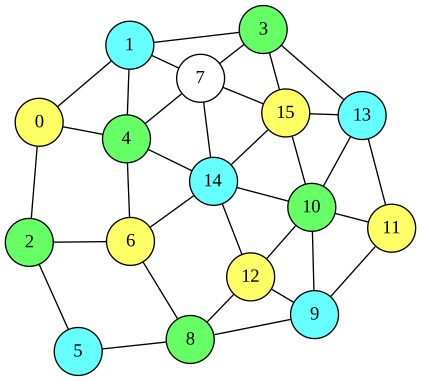
The function qbpp::onehot_to_int() returns a vector of integers in the range $[0,m−1]$, where each entry indicates the position of the 1 in the corresponding row of the one-hot matrix. If a row is not a valid one-hot vector, the function returns $−1$ for that row. In this case, the node color becomes $-1 + 1 = 0$, so the node is drawn in color 0 (white).
Result for $m=4$
This program produces the following output:
onehot = 0
different = 0
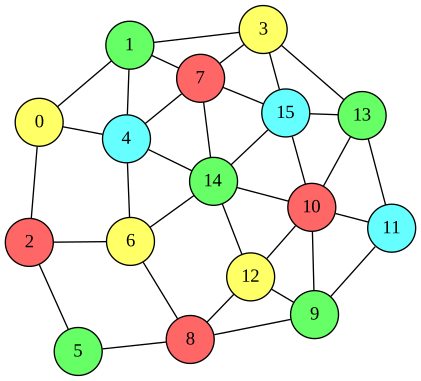
Therefore, a valid 4-coloring is found:
Result for $m=3$
We also run the same program with $m=3$. It then produces:
onehot = 1
different = 0
This output indicates that the solver failed to assign a color to exactly one node (i.e., one row is not one-hot). The resulting graph shows that node 7 is left uncolored: